Unlock Your Potential: 7 Tips to Increase Typing Speed
Learn 7 essential tips, from mastering touch typing to practicing with purpose, to break your speed limits and boost your WPM.
Read MoreHave you ever watched an expert typist and marveled at how their fingers fly across the keyboard, seemingly with a mind of their own? It's a state of complete "flow," where thoughts translate to text almost instantly, without the conscious effort of locating individual keys. This seemingly magical ability isn't a special talent—it's the result of a well-trained neurological process known as muscle memory.
Understanding the science behind muscle memory is the key to unlocking your own typing potential. It transforms practice from a repetitive chore into a deliberate process of wiring your brain for speed and accuracy. Let's explore how it works and how you can build it effectively.
Despite its name, muscle memory doesn't actually reside in your muscles. It's a form of **procedural memory**, which is stored in your brain. This is the same type of memory you use to ride a bike, play a piano, or sign your name. These are complex motor tasks that, through repetition, become automatic and no longer require conscious thought.
When you first learn to type, your brain works hard. The prefrontal cortex, responsible for conscious thought and planning, is highly active as you think, "Okay, I need to type the letter 'T'. Where is it? My left index finger needs to move up and to the left." This process is slow, clunky, and mentally exhausting.
With practice, the task is gradually handed off to different parts of the brain. The **motor cortex** begins to store the specific sequences of finger movements, and the **cerebellum** refines these movements, making them smoother, faster, and more accurate. The neural pathways associated with typing common letter patterns (like 'the', 'and', 'ion') become stronger and more efficient, like a well-trodden path in a forest.
Eventually, the action becomes so ingrained that the conscious brain is freed up entirely. You simply think of the word, and your fingers execute the command. This is the essence of touch typing.
Building muscle memory isn't just about mindless repetition; it's about the *quality* of that repetition. Bad habits, practiced repeatedly, create strong but incorrect muscle memory that is incredibly difficult to unlearn. Here are the foundational principles for building it correctly.
This is the most critical rule. When you practice, you are giving your brain a blueprint to follow. If your blueprint is full of errors, you are training your fingers to be inaccurate. The brain doesn't distinguish between a "correct" keystroke and a "mistake" during the initial learning phase; it just records what you do most often.
How to implement this: Slow down to a pace where you can achieve near-perfect accuracy (aim for 98%+). It will feel painfully slow at first, but you are building a solid, error-free foundation. Speed is a natural byproduct of accuracy, not the other way around.
You can't build a house by starting with the roof. Similarly, you can't master typing by randomly pecking at keys. An effective learning process is methodical and builds upon a solid foundation.
How to implement this: Start with the home row (ASDF JKL;). Once your fingers can find these keys without thought, introduce a few new keys at a time. Our beginner typing lessons are designed around this very principle, ensuring you don't get overwhelmed and that each new skill is built upon a previously mastered one.
The brain consolidates procedural memory during rest. This is why a short, focused 15-minute practice session every day is far more effective than a two-hour cram session once a week. Daily repetition strengthens the neural pathways before they have a chance to weaken, leading to much faster and more permanent skill acquisition. We recommend our 15-minute daily routine for optimal results.
To build true muscle memory, your brain must learn to rely on tactile feedback (the feel of the keys) and proprioception (the sense of your fingers' position in space). Every time you look down at the keyboard, you are reinforcing your brain's dependence on visual cues and short-circuiting the muscle memory process.
How to implement this: This is a non-negotiable rule of touch typing. It will feel awkward, and you will make mistakes, but forcing your brain to work without visual input is the only way to make the connection between your fingers and your brain automatic.
The ultimate goal of building typing muscle memory is to achieve **automaticity**. When the physical act of typing becomes unconscious, it frees up your cognitive resources. You can then focus entirely on the *content* of what you are writing—your ideas, your arguments, your code, your story—without being bogged down by the mechanics of getting it onto the page. Your keyboard transforms from an obstacle into a seamless extension of your thoughts.
The journey requires patience, but the reward is a fundamental skill that will enhance your productivity and reduce mental fatigue for a lifetime.
Ready to start building your muscle memory? Begin your journey with our free, structured typing lessons today.

Learn 7 essential tips, from mastering touch typing to practicing with purpose, to break your speed limits and boost your WPM.
Read More
Stuck at a typing plateau? These five targeted exercises focus on accuracy, rhythm, and difficult key combinations to help you achieve elite typing speeds.
Read More
Learn how to set up your workspace and adopt healthy habits to prevent strain and type comfortably for years to come.
Read More
Discover the science behind the typing speed-accuracy tradeoff and learn how to find your personal sweet spot for maximum efficiency.
Read More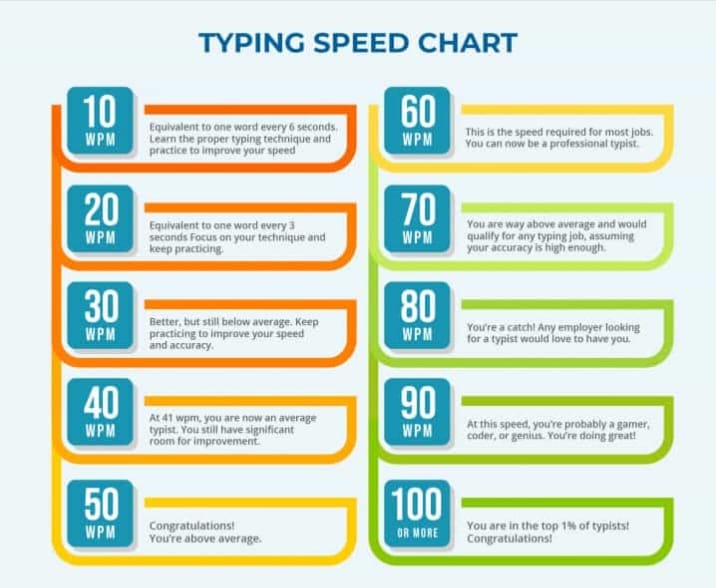
Are bad habits slowing you down? Learn to identify and fix 5 common typing mistakes, from poor posture to sacrificing accuracy for speed.
Read More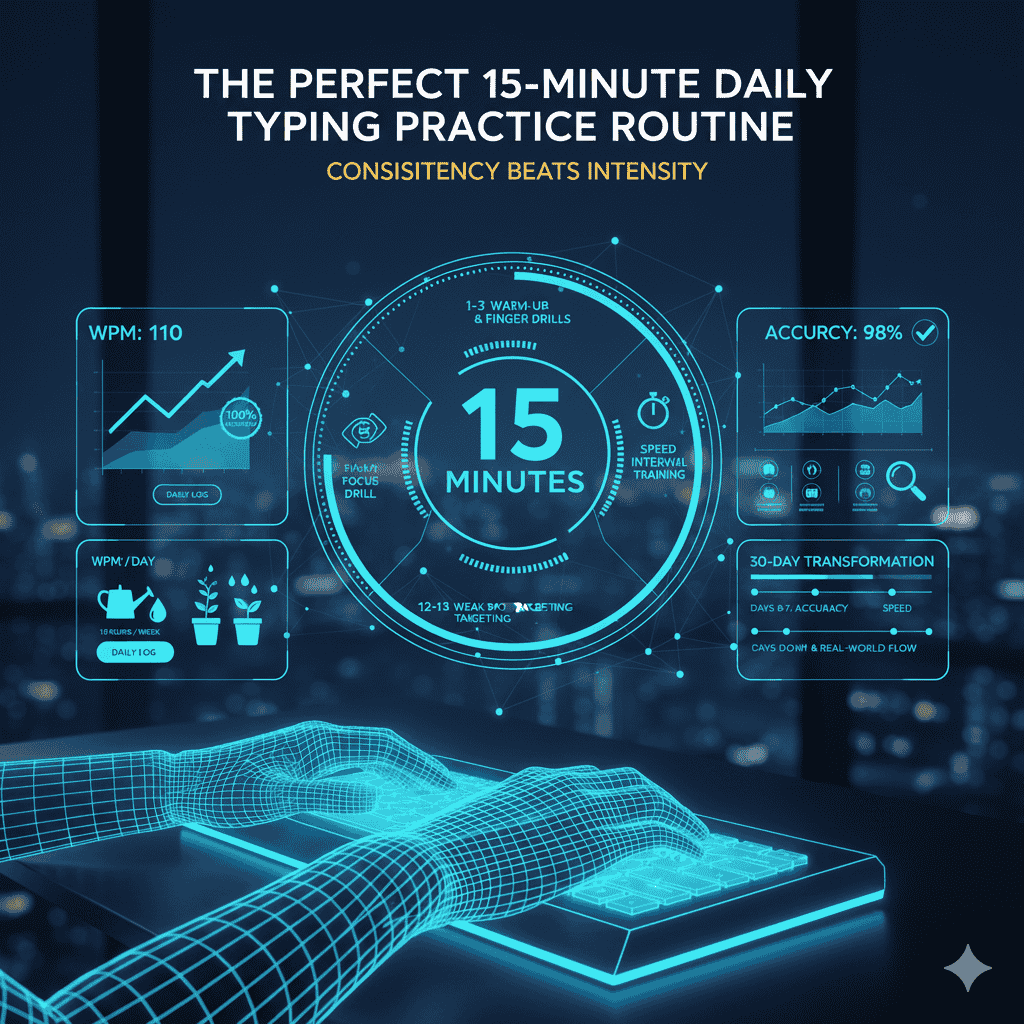
Maximize your typing improvement with this science-backed 15-minute daily practice routine. Build speed and muscle memory efficiently.
Read More