The Science of Muscle Memory: How Your Fingers Learn to Type
Discover the neuroscience behind touch typing and learn the best techniques to train your fingers to type faster and more accurately.
Read MoreYou've just completed a typing test and the results are in: a collection of numbers like WPM, accuracy, and character counts. But what do these metrics actually mean? Is your score "good"? And most importantly, how can you use this data to become a faster, more efficient typist?
A typing test isn't a final judgment on your ability; it's a diagnostic tool. Understanding your results is the first step toward deliberate practice and measurable improvement. This guide will break down the key metrics so you can read your results like a pro.
What it is: Net WPM is the most important metric for measuring your real-world typing speed. It calculates how many words you can type correctly per minute, accounting for the time lost to errors.
How it's calculated: The standard formula is `(Total Characters Typed / 5) / Time in Minutes`, adjusted for uncorrected errors. Dividing by five is the industry standard because the average length of a word in English is five characters. This allows for a fair comparison across different texts.
What's a good score?
Your Net WPM is your true productivity score. It's the number that matters most for getting work done efficiently.
What it is: Gross WPM measures your raw finger speed without penalizing for errors. It tells you how fast you *could* be if you typed with perfect accuracy.
Why it's useful: The gap between your Gross WPM and Net WPM is a direct indicator of how much your errors are slowing you down. If your Gross WPM is 80 but your Net WPM is only 65, you know that inaccuracy is your biggest barrier to improvement. Closing this gap by focusing on precision will dramatically boost your effective speed.
What it is: This is the percentage of characters or words you typed correctly during the test.
Why it's the most important metric for learners: You cannot achieve high speeds without a foundation of accuracy. Chasing speed while making frequent mistakes only trains your fingers to be sloppy. As our article on the Speed vs. Accuracy Tradeoff explains, a slower typist with high accuracy is often more productive than a faster, error-prone one.
For example, correcting a single mistake involves at least three extra keystrokes (backspace, re-type, backspace to delete the extra character if a space was added). This devastates your rhythm and your Net WPM. Aim for **96-98% accuracy** as your baseline. Once you can maintain that, your speed will increase naturally and sustainably.
Your test results are a roadmap. Here’s how to read it:
Remember, a single typing test is just a snapshot in time. Your performance can be affected by your mood, energy level, and environment. The real value comes from tracking your progress over time.
Use a typing test as a weekly check-in to see how your practice is paying off. Don't be discouraged by a single bad score. Focus on the long-term trend. As long as your average Net WPM and Accuracy are gradually climbing, you are on the right path to becoming a true Type Master.
Ready to get your baseline? Take our free WPM Typing Test and start your journey to faster, more accurate typing today.

Discover the neuroscience behind touch typing and learn the best techniques to train your fingers to type faster and more accurately.
Read MoreLearn 7 essential tips, from mastering touch typing to practicing with purpose, to break your speed limits and boost your WPM.
Read More
Stuck at a typing plateau? These five targeted exercises focus on accuracy, rhythm, and difficult key combinations to help you achieve elite typing speeds.
Read More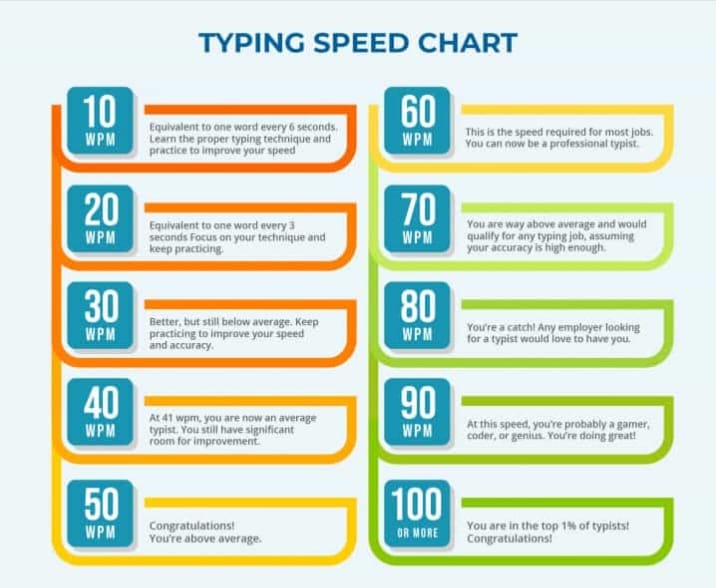
Are bad habits slowing you down? Learn to identify and fix 5 common typing mistakes, from poor posture to sacrificing accuracy for speed.
Read More
Learn why your typing speed drops during tests and high-pressure situations. Discover proven techniques to overcome typing anxiety.
Read More
Maximize your typing improvement with this science-backed 15-minute daily practice routine. Build speed and muscle memory efficiently.
Read More